

New Edition – Award Winning Caregiver’s Path to Compassionate Decision Making – only at Barnes and Noble
October 18, 2018 by Viki Kind
Filed under Ethics In Action, Featured
AVAILABLE ONLY at Barnes and Noble Caregiver’s Path ebook and print book
Recommended by:
- Journal of Gerontological Social Work
- Pain Management Nursing Journal
- Journal of the Catholic Health Association of the United States
- Alzheimer’s Association
- Stanford University School of Medicine Chair – Moira Fordyce MD, MB ChB, FRCPE, AGSF, Geriatrician – Adjunct Clinical Professor
- NAMI Advocate – National Alliance on Mental Illness
- Harry R. Moody, Ph.D., Director of Academic Affairs, AARP
- Christopher and Dana Reeve Foundation Paralysis Resource Center
- Muscular Dystrophy Association
- Journal of Hospital Librarianship
(Second edition says “Bonus Material” on the cover.)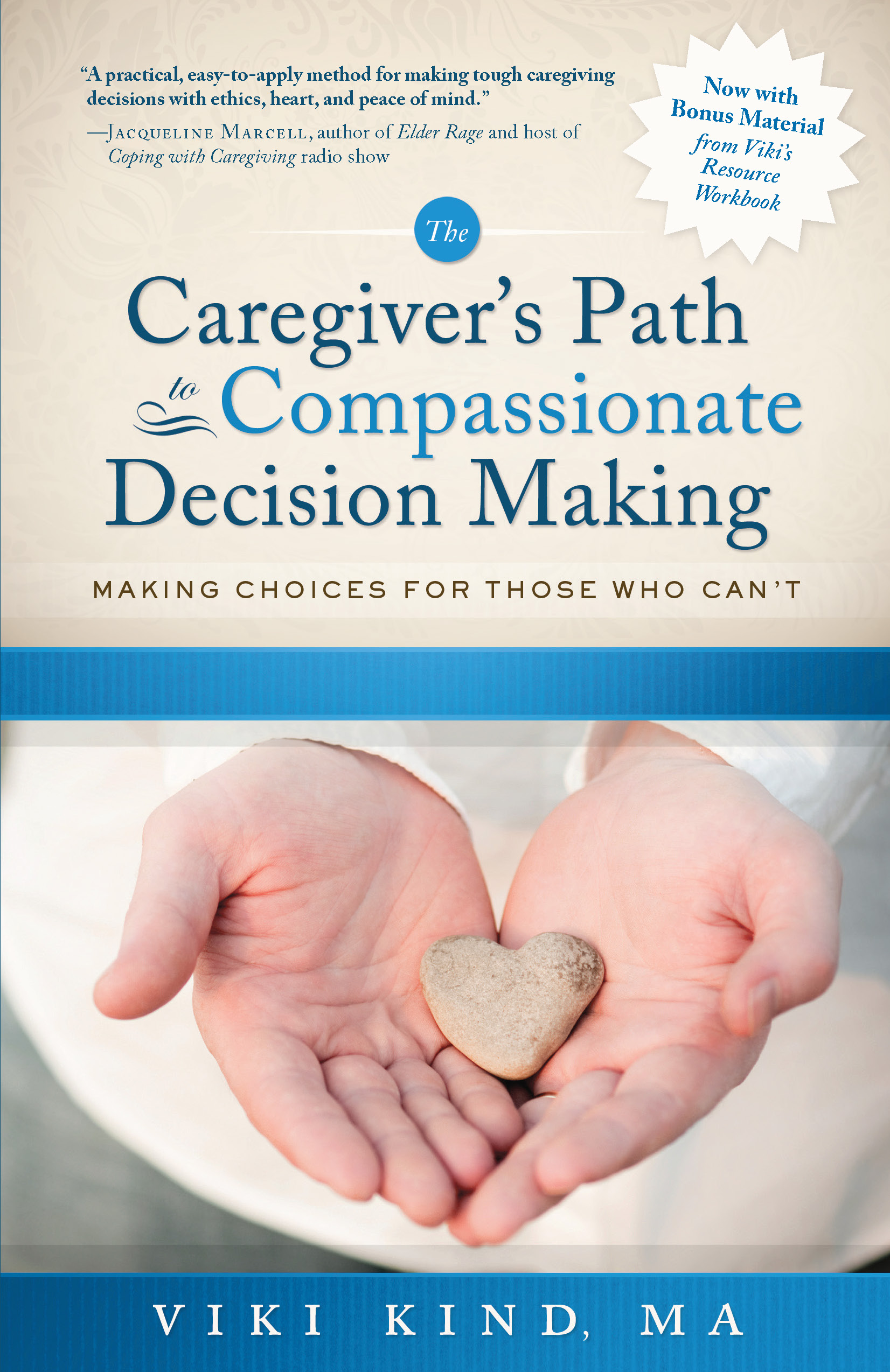
You know how difficult—even heartbreaking—it can be to make decisions for someone with dementia, stroke, Parkinson’s, developmental disability, mental illness, or other brain injury. Feeling confident that you’ve made the right decision would be a welcome relief from the worry and guilt you may be feeling.
The Caregiver’s Path is an invaluable resource for caregivers struggling to make the right decisions, whether it’s taking away the car keys, moving to a long-term care facility or making the difficult medical and end-of-life choices.
A simple, step-by-step process which adjusts as your loved one’s mental capacity changes:
- Guidelines to help you determine if your loved one or patient can make decisions, who should make the decisions, and how to make better decisions
- Questions to use in almost any medical or quality-of-life situation that will help you gather all of the information you need
- Techniques for improving communication between patients, families and caregivers
The Caregiver’s Path provides tools and strategies to help answer the question, “Am I doing the right thing?”
“An excellent guide for families left struggling and feeling overwhelmed when making decisions for those who are incapacitated. The tone is conversational, examples familiar and explanations simple and clear. With comfort and assurance, decisions are made systematically, while respecting the wishes of the individual. Every caregiver should read this guide before there is a crisis.” Edna Ballard, MSW, ACSW, Duke Family Support Program; senior fellow, Center for the Study of Aging and Human Development; Bryan Alzheimer’s Disease Research Center
“It is a valuable resource that covers information needed to make all levels of decisions. I have never found this information discussed in such a clear, compassionate manner. GET THE BOOK.” Carol E. Pollard, RN, LMT
“The Cards I’ve Been Dealt” Resource Helps to Manage the Transitions That a Senior Faces in a Positive Way
March 23, 2013 by Viki Kind
Filed under Ethics In Action
The Cards I’ve Been Dealt is a wonderful new resource available for facilitating conversations about the important transitions in a senior’s life or for creating your own amazing second half of life. If you like the Go Wish Cards (www.gowish.org) for end-of-life decision making, then you are going to love The Cards I’ve Been Dealt (http://thecardsivebeendealt.com). There are three different decks of cards to help you facilitate important conversations with your clients. The first deck is called The Daily Activities cards which can be used as a need’s assessment tool to help you discover and discuss what the senior can still do and what he or she needs help with. I will be using The Daily Activities cards in my work because my clients include families who are caring for cognitively impaired seniors and people with disabilities. I really like that the cards use a positive approach to talking about this difficult subject matter. The family caregiver will understand the changes that need to be made and can begin to develop an action plan for the senior’s needs.
The Wishes and Values cards, which contain 50 open-ended question cards, focuses on uncovering what matters most and what brings that individual joy and satisfaction. I can see these cards being used by professionals such as therapists, probate and elder law attorneys, financial planners, etc. who are talking with seniors about building good life plans. The Life Practices cards include 50 positive aging skills and practice cards which can enhance senior’s lives. (I need to begin to use the Life Practices Cards since I turned 49 this year and want to get a head start on aging positively.) Also included on the website are worksheets and downloadable tools to use as you navigate these important conversations with your clients or for yourself to use.
Have a kind and respectful day.
Tips for communicating with a mid-stage (or later) Alzheimer’s patient by Carole Larkin
July 18, 2012 by Viki Kind
Filed under Ethics In Action
By Carole Larkin MA,CMC,CAEd,QDCS,EICS
ThirdAge Services LLC in Dallas, Tesas
thirdageservices@gmail.com
www.thirdageservices.com
Tips for communicating with a mid-stage (or later) Alzheimer’s patient
Ever feel like your loved one is ignoring you or that you just weren’t getting through to your loved one? Try some of these tips to see if they help.
1. Make eye contact. Always approach them face-to-face and make eye contact. Use their name if you need to. It is vital that they actually see you and that their attention is focused on you. Read their eyes. Always approach from the front as approaching and speaking from the side or from behind can startle them.
2. Be at their level. Move your head to be at the same level as their head. Bend your knees or sit down to reach their level. Do not stand or hover over them – it is intimidating and scary. They can’t focus on you and what you are saying if they are focused on their fear.
3. Tell them what you are going to do before you do it. Particularly if you are going to touch them. They need to know what is coming first so that they don’t think that you are grabbing them.
4. Speak calmly. Always speak in a calm manner with an upbeat tone of voice, even if you don’t feel that way. If you sound angry or agitated, they will often mirror that feeling back to you and then some.
5. Speak slowly. Speak at one half of your normal speed when talking to them. Take a breath between each sentence. They can not process words as fast as non-diseased people can. Give them a chance to catch up to your words.
6. Speak in short sentences. Speak in short direct sentences with only one idea to a sentence. Usually they can only focus on only one idea at a time.
7. Only ask one question at a time. Let them answer it before you ask another question. You can ask who, what, where and when, but NOT why. Why is too complicated. They will try to answer, fail and get frustrated.
8. Don’t say “remember”. Many times they will not be able to do so, and you are just pointing out to them their shortcomings. That is insulting, and can cause anger and/or embarrassment.
9. Turn negatives into positives. For example say “Let’s go here” instead of “Don’t go there”. Be inclusive and don’t talking down to them as if they were a child. Respect the fact that they are an adult, and treat them as such.
10. Do not argue with them. It gets you nowhere. Instead, validate their feelings, by saying” I see that you are angry (sad, upset, etc…). It lets them know that they are not alone and then redirect them into another thought. For example “It sounds like you miss your mother (husband, father, etc…). You love them very much, don’t you? Tell me about the time…” Then ask for one of their favorite stories about that person)
Have a kind and respectful day.
Bringing Kindness to Nursing Homes from Hayes Rowan
June 4, 2012 by Viki Kind
Filed under Ethics In Action
Here is another wonderful idea Hayes Rowan sent to me for how we can show love and comfort to those who might need a little support. Here is what he wrote:
Like to ask, if we may, all you good folks out there to make two bouquets of dried flowers this summer, & bring one to the nearby nursing home, giving it to the first resident whose eyes brighten at the sight of it – & chances are that won’t take too long.
The fleurs will last all winter – their staying power of course is much greater than fresh flowers. And most dry just beautifully: Lavender, Roses, Daffodils, Daisies, Garlic Chives, Statice, Strawflowers, Mums, the Purple Alium, Marigolds & more. But petunias & impatiens, tulips & their like – they don’t dry so well.
If you’re not a gardener, ten to one the neighbor who is will happily contribute.
How to? Cut the stems long & bind small bunches at the base with light wire or whathaveyou. Hang them upside down – perhaps with improvised S-hooks and an unused fishing rod perched horizontally (upside down to keep the stems from buckling under the blossoms’ weight). This will give flowers with longer, slender petals, like Daisies, a sort of exuberant look, recalling Joyce Kilmer & her trees that look at God all day, lifting their leafy arms to pray. (Might have to tighten that wire once or twice as the stems dry out.) Oh yes, salad dressing bottles & such, make for quite serviceable vases.
We’d like to hear if you do this, and something of your interaction in the long-term care facility.
I THINK THAT I SHALL NEVER SEE A POEM AS LOVELY AS A TREE
– Joyce Kilmer
Never underestimate the powers of flowers.
– anon
Have a kind and respectful day.
Join Viki at the Association of Professional Chaplain’s Conference June 21-24
June 1, 2012 by Viki Kind
Filed under Ethics In Action, Uncategorized
Viki will be presenting two workshops at the Association of Professional Chaplain’s Conference in Schaumberg, IL on June 21-24.
Renaissance Hotel and Convention Center
Schaumburg, IL
http://www.professionalchaplains.org/index.aspx?id=2144
MISSION/VISION/VALUES of the Professional Chaplain
Mission
The Association of Professional Chaplains promotes quality chaplaincy care through advocacy, education, professional standards and service to its members.
Vision
Strengthen the multifaith and multicultural professional competency of chaplains.
Empower chaplains to demonstrate quality outcomes to those whom they serve.
Demonstrate the distinctive value of professional chaplaincy, which can be understood by external stakeholders.
Collaborate with accrediting and hiring institutions, as well as other organizations with which we have a common interest, in order to promote professional chaplaincy.
Values
Dignity and worth of all persons.
Faith as an essential dimension of wholeness.
Chaplaincy care of persons, communities, organizations and systems.
Inclusivity and diversity.
Justice and equality for all.
Professional competency and ethical practice.
Have a kind and respectful day.
Alzheimer’s Educational Conference May 31 & June 1
May 9, 2012 by Viki Kind
Filed under Ethics In Action
Join Viki at the Alzheimer’s Community Care Conference on May 31 and June 1 at the Palm Beach County Convention Center
To Register: http://www.alzcare.org/
Conference Fees
• Conference fees include all sessions, parking, conference
materials, breakfast, breaks and lunch for both days.
Professionals will receive up to 8 CEUs.
• There will be no refunds after May 18, 2012
• If you wish to send someone in your place, please
call (561) 683-2700 or email info@alzcare.org
at least two days prior to the conference. Requests
received after this time may not be processed.
Family Caregivers:
? $30 ONE Day Pass *Please indicate which day you will attend:
? Thursday, May 31 ? Friday, June 1
? $50 TWO Day Pass
General Attendance:
? $125 ONE Day Pass
*Please indicate which day you will attend:
? Thursday, May 31 ? Friday, June 1
? $195 TWO Day Pass
Thursday – May 31, 2012
8:00 – 9:00 AM Registration, Breakfast, Exhibit Hall
9:00 – 11:30 AM Opening Remarks, Morning Plenary Session
featuring Viki Kind and Breakout Sessions
11:30 – Noon Visit the Exhibit Floor
12:00 – 1:30 PM Lunch at Caregiver Table with Larry Polivka, Ph.D.
1:45 – 4:30 PM Breakout Sessions
Friday – June 1, 2012
8:00 – 9:00 AM Registration, Breakfast, Exhibit Hall
9:00 – 11:30 AM Morning Plenary Session featuring Teepa Snow
and Breakout Sessions
11:30 – Noon Visit the Exhibit Floor
Noon – 1:30 PM Lunch featuring Keynote Speaker, Dan Rather
1:30 – 3:30 PM Reception
Have a kind and respectful day.
Poll Finds Wide Gap Between the Care Patients Want and Receive at End of Life Few older Californians discuss treatment preferences with their doctors
February 15, 2012 by Viki Kind
Filed under Ethics In Action
Poll Finds Wide Gap Between the Care Patients Want and Receive at End of Life
Few older Californians discuss treatment preferences with their doctors
(Oakland, CA) – When it comes to how they want to spend their final days, Californians prefer to die a natural death at home without being a burden, financially or emotionally, on their families. Yet according to a new poll released today by the California HealthCare Foundation, a disparity exists between what people say they want at the end of life and what actually occurs.
The survey, Final Chapter: Californians’ Attitudes and Experiences with Death and Dying, finds nearly 8 in 10 Californians said that if they were seriously ill, they would want to speak with their doctor about end-of-life care, but fewer than 1 in 10 report having had a conversation, including just 13% of those age 65 or older.
Additionally, while 82% say that it is important to put their wishes in writing, less than one quarter have actually done so. More than half say they have not talked with a loved one about the kind of care they want at the end of life.
The survey explores differences in attitudes toward death and dying among major ethnic groups in California. Top concerns vary. For example, Latinos rate “living as long as possible” much more highly than other groups.
”With end-of-life treatment, there is a clear gap between wishes and actions,” said Mark D. Smith, MD, MBA, president and CEO of the California HealthCare Foundation, which commissioned the survey. “People consistently stress they want to die comfortably and without pain. If so, the single most important thing they can do is to talk to their loved ones and physician, and put their wishes in writing, something most Californians aren’t doing.”
Preferences Not Being Followed
The survey finds patients’ wishes regarding treatment are not always honored. Only 44% of Californians who have lost a loved one in the last 12 months say their loved one’s end-of-life preferences were completely followed and honored by their medical providers. These numbers drop to 26% for those whose loved ones experienced a language barrier and 25% for patients who were uninsured at the time of death.
Similarly, most Californians would prefer to die at home, but that is not typical. Seventy percent of those surveyed said their home is their preferred place of death, but only 32% passed away in their homes, according to death records from the California Department of Public Health.
Paying for the Conversation
A major barrier to effective end-of-life planning is the lack of frank discussion between patients and health care providers. The average 15-minute office visit does not leave time to explore the natural progression of illness and the preferred treatment options for those nearing death.
As part of its original package to expand health coverage, the Obama Administration proposed requiring public and private insurance to cover voluntary conversations about end-of-life planning between patients and providers. After the issue became politicized, the idea was dropped from the final bill.
The new poll finds broad support among Californians, regardless of political affiliation, for reimbursing doctors to talk about end-of-life options. Eighty-four percent of Democrats, 72% of Republicans, and 80% of Independents say it would be a good idea to pay for the conversation.
Putting a Plan in Place
To help patients have their say if they are unable to speak, CHCF promotes the use of Physician Orders for Life-Sustaining Treatment (POLST). Developed in Oregon two decades ago, POLST is a standardized medical order form (in California it is printed on bright pink paper) that indicates the specific types of treatment a seriously ill patient does or does not want. The voluntary form is signed by the doctor and the patient and is designed to travel with a patient across medical settings.
POLST complements, but does not replace, an Advance Health Care Directive. An Advance Directive, which should be filled out by any adult regardless of one’s health status, provides a broad outline of a person’s wishes relating to end-of-life care, and allows an individual to appoint a “health care proxy” – the person they want to speak on their behalf. Only POLST, however, carries the power of a physician order.
According to the survey, nearly two-thirds of Californians said they would want to complete a POLST form if they became seriously ill, including 77% of those who are 65 or older. Seventy-one percent said they would want a seriously-ill loved one to complete the form so they would understand their wishes.
The State of Palliative Care
In 2009 nearly 100,000 Californians with serious illness died in hospitals, according to public health records. Palliative care treats pain and other symptoms, provides psychosocial and spiritual support, and ensures that medical treatments align with patient and family wishes. Increasingly, hospitals are recognizing the enormous value of palliative care to patients who are seriously ill.
CHCF is releasing an accompanying report on palliative care: When Compassion Is the Cure: Progress and Promise in Hospital-Based Palliative Care. Produced by the National Health Foundation and the University of California, San Francisco Palliative Care Program, it profiles the state of palliative care in California’s acute care hospitals.
Among the findings:
• Palliative care consultation services have experienced a great deal of growth in recent years: Between 2007 and 2011, pediatric services increased by 128%, while adult services increased by 24%.
• Most palliative care services have modest budgets, with 60% operating on less than $300,000 annually.
• Every major metropolitan area in California except Los Angeles increased the number of hospital-based palliative care programs between 2007 and 2011. The percentage of Los Angeles hospitals with such programs actually decreased.
More Online
Additional resources, including a consumer guide for developing an Advance Directive from the American Bar Association, and videos of individuals and family members reflecting on their experiences with these issues, can be found at www.chcf.org/endoflifecare.
###
About Final Chapter: Californians’ Attitudes and Experiences with Death and Dying
On behalf of CHCF, the survey was conducted by Lake Research Partners in late 2011 among a representative sample of 1,669 Californians age 18 and older, including 393 respondents who have lost a loved one in the past 12 months. The margin of error is 2.4 percentage points for the total results.
About When Compassion Is the Cure: Progress and Promise in Hospital-Based Palliative Care
This survey was developed by the Palliative Care Program at the University of California, San Francisco and administered by the National Health Foundation in the fall of 2011. All 377 acute care hospitals in California were asked to participate. Ninety-six percent responded, and 71% of respondents provided detailed information about their palliative care programs.
About the California HealthCare Foundation
The California HealthCare Foundation works as a catalyst to fulfill the promise of better health care for all Californians. It supports ideas and innovations that improve quality, increase efficiency, and lower the costs of care. For more information visit www.chcf.org.
About the Coalition for Compassionate Care of California
The Coalition for Compassionate Care of California is a statewide partnership of nearly 200 regional and statewide organizations dedicated to the advancement of palliative medicine and end-of-life care in California. For more information visit www.CoalitionCCC.org.
Media Contacts:
Steven Birenbaum, California HealthCare Foundation
510-587-3157, sbirenbaum@chcf.org
Annette Majerowicz, Behr Communications
310-576-0949, Annette@behr-communications.com
I will be at the Fearless Caregiver Conference in Boca Raton on Thursday to receive the 2011 Caregiver Friendly Award my book just won!
July 10, 2011 by Viki Kind
Filed under Ethics In Action
THE CAREGIVER’S PATH TO COMPASSIONATE DECISION MAKE: Making Choices For Those Who Can’t IS THE WINNER OF THE 2011 CAREGIVER FRIENDLY® AWARD FROM TODAY’S CAREGIVER MAGAZINE.
Today’s Caregiver, the first national magazine for all family and professional caregivers, and caregiver.com announce the 2011 Caregiver Friendly® Award recipients. The Caregiver FRIENDLY® Awards are designed to celebrate products, services, books and media created with the needs of caregivers in mind.
About The Caregiver Friendly Awards:
Caregiver Friendly® Awards are presented by Today’s Caregiver magazine to celebrate outstanding books, media, products and services designed with the best interest of the family caregiver in mind. Today’s Caregiver, launched in 1995, is published by Caregiver Media Group, which also produces the Fearless Caregiver Conferences, www.caregiver.com and The Fearless Caregiver book, which teaches caregivers how to become their loved one’s fearless advocates within the healthcare system.
http://www.caregiver.com/caregiverfriendly/2011/2011_winners.htm
“The average caregiver is responsible for over $40,000 in health related expenditures each year, in either personal or directed funds,” says Gary Barg, Today’s Caregiver editor-in-chief. “This award is designed to help family caregivers recognize and reward those organizations who will care for them in as committed a manner as they care for their loved ones.”
Fearless Caregiver Conference in Boca Raton, FL
Thursday July 14, 2011
8:00am – 2:30pm
Family Track and Professional Track with CEUs
Embassy Suites Hotel
661 NW 53rd Street
Boca Raton, FL 33487
http://www.caregiver.com/fearlessconference/index.htm
Have a kind and respectful day.
Join me in Portland on June 30th – Sponsored by AARP, Multnomah County Family Caregiver Support and Providence Home Services
June 20, 2011 by Viki Kind
Filed under Ethics In Action
AARP, Multnomah County Family Caregiver Support and Providence Home Services invite you to attend the program:
“Empowering Caregivers Who Have to Make Difficult Choices”
Thursday, June 30th
7:00 pm
Providence Cancer Center Auditorium
4805 NE Glisan—Portland
Doors open at 6:30 – Lecture begins at 7PM
The event is free, but space is limited. Please rsvp to:
http://aarpor-empowering-caregivers.eventbrite.com/
or call 503-988-3646
Join me on a teleconference call with The Purposeful Planning Institute on June 10th.
June 3, 2011 by Viki Kind
Filed under Ethics In Action
I am honored to be the guest speaker on a teleconference call with The Purposeful Planning Institute. They are an amazing group of people dedicated to making a difference in the lives of others.
Empowering Family Caregivers who are Making the Difficult Decisions
Date: Friday, June 10th
Time: 11:00am ET
http://www.johnawarnick.com/kind10june2011/
See registration information below.
The Purposeful Planning Institute offers a variety of services and learning opportunities designed for professionals who serve families of wealth through the Purposeful Planning Collaboration, The Learning Academy and Purposeful Planning Conferences and Workshops.
The Institute also offers an invaluable and unique service for planned giving professionals, community & family foundation leaders, philanthropic consultants, and other advisors who are genuinely dedicated to philanthropy through the Purposeful Philanthropy Forum.
Registration & Participation
If you are not a member of the Purposeful Planning Collaboration and would like to request a guest PIN, or if you would like to have your PIN resent to you, please contact us or visit http://maestroconference.com/dashboard and enter your email address in the ‘Forgot PIN’ section on the right side of the page.
Important Note: The Maestro Conference system does not always recognize PINs from participants calling in on internet based phones, VOIP or Magic Jacks. However, it does integrate well with Skype. We apologize for any inconvenience and encourage you to let us know if this affects your ability to participate in any of our teleconferences.
Participant Dashboard
If you are at a computer during the call you may access the participant dashboard by clicking on this link: http://maestroconference.com/dashboard. Logging on to the participant dashboard allows you to send messages to the conference host, view PDFs, Power Point presentations and other materials that may be posted there.
If you would like to invite a guest to call in, please feel free to do so, but please ask them to contact us to obtain the call-in number and a personal PIN.
Have a kind and respectful day.
